In luxury multifamily development, there is an amenities race. Residents are looking for more from shared spaces and are interested in unique amenities that add to their daily lives. The question for developers now is how to create differentiation without just adding noise.
At Gables Riverwalk in Fort Lauderdale, the design identity had a biophilic emphasis from the start. In addition to the expected plants, natural materials, and warm finishes, we were asked to carry a consistent tone across spaces designed for recovery, wellness, and quiet focus while connecting to the biophilic design. Each room has a different function and a different energy, and the artwork needs to support that without feeling scattered.
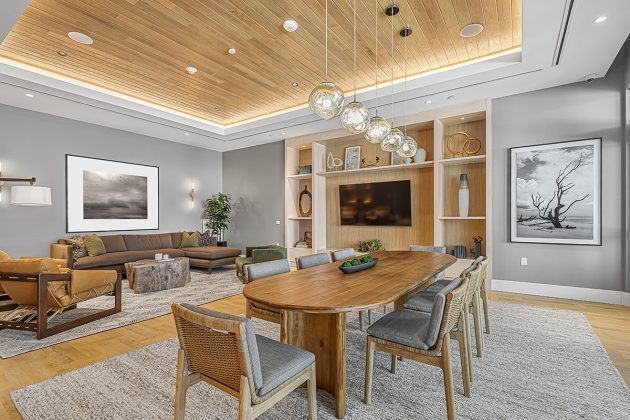
The club lounge at Gables Riverwalk. Two of Parker Stewart’s coastal landscapes anchor opposite walls, giving a large, multi-use space a clear visual identity without competing with the architecture.
This is where Parker Stewart’s photographs fit. Parker is a Savannah-based photographer looking at the layers of both atmosphere and time. Having grown up in North Carolina, splitting summers between the coast and the Appalachian mountains, surfing, fishing, sailing, water became a core subject that continued to his move to Savannah and travels to the Georgia and South Carolina lowcountry. “The layers and seasonal changes in the mountains made me a keen observer. And my time on the coast, surfing, fishing, and sailing as a child, has made water a core subject and aspect to my work.”
Though he also works in color, a big part of his choice of work is in black and white. “Black and white photography amplifies this sense of mood and mystery. It abstracts the scene just enough to separate it from reality, creating space for the viewer’s interpretation. The tonal gradients of the fog, the stark contrast of oak limbs against the sky, the interplay of marsh grass and water—all take on a heightened sense of presence in monochrome.”
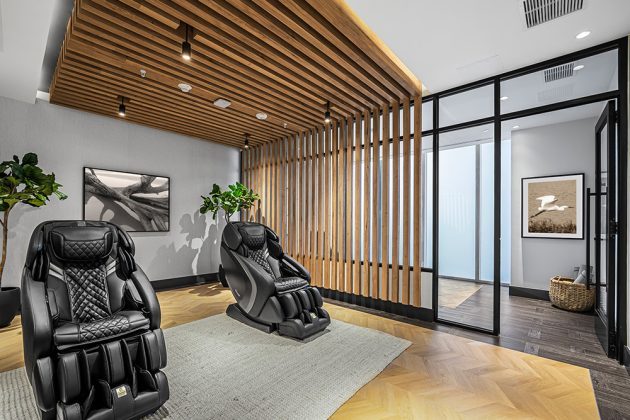
The recovery room at Gables Riverwalk. Parker Stewart’s Untitled (2024) on the left wall, a close study of coastal root systems that holds the room with the same tonal restraint he describes in his black-and-white work.
Parker’s photographs are placed across the amenity level at Riverwalk and the leasing office. Spaces include the recovery room, yoga studio, private massage room, and lounge, just to name a few. His works help the visual language of the level be consistent, which ultimately helps the biophilic interior design feel more intentional than just themed.
One of his images, “Untitled (Pelicans)” has an interesting story behind it. It was taken on a stormy morning off the coast of Georgia. “Getting on the boat early in the summer is always a goal, the clouds are always so billowy and beautiful at that time of day and they make for great subjects or backgrounds. The tide was low and I pulled up to a sandbar that I often walk to photograph the swift moving water.” He continues, “I saw this large flock of pelicans flying towards me from down the beach and I set up my tripod and quickly took the filter off so I could capture them coming across the frame. While I thought they would just continue to fly north in a long lovely line they suddenly turned and started flying directly toward me and then made a big arch above me which I captured in this frame.” His eye is drawn to the dramatic light in the clouds and the pelicans above, but his favorite part is the line of pelicans at the bottom of the frame. “If you look closely you can see the reflection of those low flying birds in the tidepools, I think it’s a beautiful detail.”
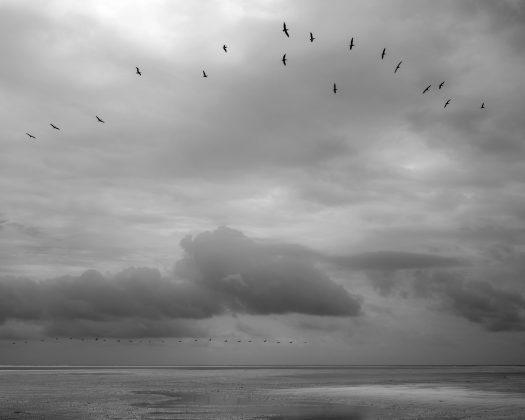
Parker Stewart, Untitled (Pelicans), 2020. Captured on a stormy summer morning off the Georgia coast. The detail Parker mentions — the reflection of the low-flying birds in the tidepools at the bottom of the frame — is there if you look for it.
In the recovery room, another work, “Pelicans & Pilings” (2024) hangs on the wall facing the recovery chairs. Pelicans are perched on weathered dock posts, their reflections pulling into still water below. It reads immediately from across the room, but take a closer look, and you’ll notice something special. Months after taking it, Parker realized that one of the birds on those pilings isn’t a pelican at all. It’s a cormorant. A single detail tucked into a large, quiet image that most people will walk past many times before catching.
That’s what makes his work strong in a residential setting. There are some details you have to find on your own. The images don’t give everything away on the first pass, which encourages revisits. “I love that people will get to experience these pieces over a long period of time. There’s always something new to see in these works. There are some details I’m hesitant to point out because it’s so fun to find them on your own.”
Parker hopes residents find their favorite parts or details of the work over time. He wants people to come back over time and catch something new with their eyes. But more than that, he hopes his work brings calmness to these spaces. “I consider these photographs to be meditations as that’s the state of mind I usually am in when I am making the work.” The intent is to have the viewer focus on the details and hold themselves there in the space for some time.
“Nelson’s Dock” is placed in the leasing office, continuing that connection the building has with biophilic design. It’s in a separate building from the amenity floor, but it’s often the first place a prospective resident slows down and decides whether the property feels like home. That same visual language carries on purpose. “It’s just nice to know that so many eyeballs will be on the work. Gallery exhibitions are temporary and private homes, while it’s an ideal setting for work like this, only get so many viewers over a lifetime. It’s awesome to know that so many people will get to interact with this work.”
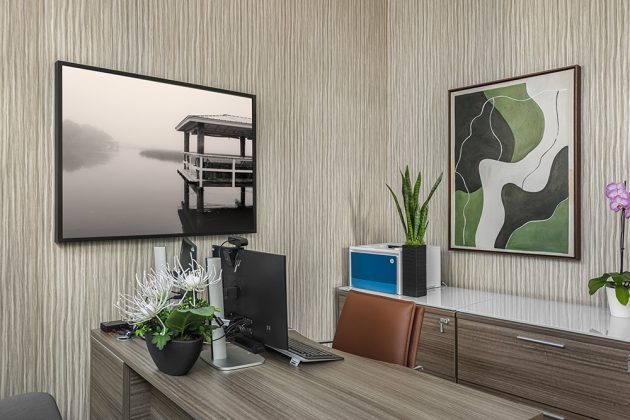
Parker Stewart, Nelson’s Dock (2021). Placed in the leasing office to carry the same tone a resident will encounter throughout the building: calm, specific, and grounded in the Georgia coast.
Great amenities get residents in the door. Artwork that’s curated with the same intention as the spaces it lives in is what makes those amenities feel complete and what gives a building a character that’s harder to replicate down the street
In addition to his work here, Parker has an exhibition opening May 1st at Laney Contemporary in Savannah; “Jack Leigh and Parker Stewart: In Place” pairs his work with the late photographer Jack Leigh’s landscapes of the Georgia and South Carolina Lowcountry. He’ll also be showing at Artemis Gallery in Maine this summer, and is working toward publishing Tideland, his long-running project documenting the changing tidal landscapes of the Southeast.
Written by David Dempsey, Director, Media Services & Content