In our work with luxury developers and the design teams who shape these projects, we see a lot of beautifully designed properties. Almost every one of them has the same blind spot. Every detail of the bathroom in a luxury property gets thought through, except the art. The marble, the fixtures, the lighting, and the finishes are all considered, and then the most personal room in the property is left without its signature.
Luxury hospitality and residential development have entered a phase where every square foot is expected to tell a story. Corridors, fitness studios, yoga rooms, and wellness lounges are being programmed with the same artistic consideration once reserved only for the lobby, while the bathroom is routinely left out of the art program. Consider how many luxury properties contain at least one in every shared space named above, plus the public restrooms off the lobby, the restaurant, the spa, and the event floor. The bathroom gets design attention everywhere except the walls. It may be the most underused canvas in the entire property, and the forward-looking owners and designers are starting to notice.
Why the Bathroom Belongs in the Budget
There’s a reason this conversation is happening now. People are paying more attention to where their money goes. Whether they’re booking a suite, signing a lease, or picking a restaurant for an anniversary, they want to know what the premium is buying. They want to know what they’re actually getting. In luxury hospitality and residential, the answer comes down to the detail of the experience. A property earns its place at the top of the market by thinking through every moment a guest or resident will feel in it. Beautiful is the starting point. What follows is what makes a property memorable.
The bathroom is one of the most concentrated of those moments. The lobby competes for a guest’s attention with people, movement, sound, and wayfinding, and the bathroom does not. A thoughtful piece of art on a bathroom wall is one of the few details a property can add that does not have to compete with anything else in the room, and one of the few that has the chance to set the property apart from every other one a guest has stayed in.
Even so, this is the room that rarely gets its own line item in the art budget. When it appears at all, it tends to be the first thing trimmed. Given everything the room has to offer, it deserves its own consideration rather than the leftovers. The cost of including it is modest. The cost of overlooking it is harder to see, but a missing detail in a room this personal is felt.
Working With the Design, Not On Top of It
A natural concern is whether artwork placed in the bathroom risks disrupting a finished interior. The concern is fair, and it is worth answering directly. Artwork in the bathroom works best when it is treated as part of the design from the start, building on what the design team has established rather than sitting on top of it.
A great interior tells a continuous story across every shared space of a property. The finishes, the lighting, the fixtures, and the joinery establish the language of that story, and the artwork makes it visible. When the public bathroom is the only space without it, the story has a gap that guests register even if they cannot name it. Filling that gap brings the design all the way into the bathroom.
The right approach depends on the room and what the room is asking for. A bespoke mural or a commissioned wall covering can turn a powder room off the lobby into the most photographed space in the property. A thoughtfully scaled framed piece, or a pairing across a vanity wall, can extend a restaurant’s design language into the restrooms guests visit. In a spa or wellness setting, the right artwork reinforces the calm that the design is already working to create. Across the amenity floors of a residential building, a coordinated program creates a continuity that residents feel without having to think about it.
Layering is another option worth considering. A thoughtfully selected framed piece against a custom wallpaper can turn a small bathroom into one of the most distinctive moments in a building, with the wallpaper and the artwork chosen as a coordinated pair rather than separately.
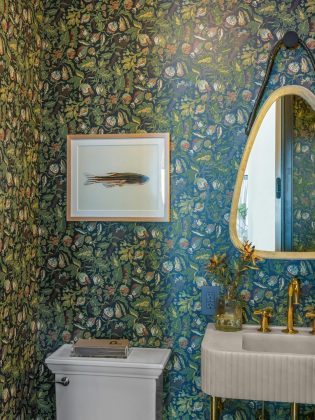
A small bathroom layered with a custom-style wallpaper and a complementary framed piece, an example of how two coordinated wall elements can transform a compact room into a signature space.
The work has to respond to what’s already in the room. Sometimes a soft tonal photograph that echoes the veining in the stone is what the room needs. Other times, a saturated piece against a quiet wall is the move, deliberately placed to create a focal point a guest will remember. The decision is always considered and always made alongside the design team’s intended vision.
This is where a curator enters the process. In our experience, the bathroom is almost always overlooked until we mention it, and the design team is usually grateful once we do. Their vision has shaped every other room in the property. Our role is to help that vision reach every wall, including the ones in rooms most projects forget. We handle the practical considerations so the design intent stays intact.
What This Looks Like in Practice
“The day we start installing the art, that’s when the building has a soul.”
— Lynn Riley Stokes, VP of Design, Gables Residential
The case for artwork in public bathrooms is strongest when you can see it in a property that has already done the work. Gables Riverwalk in Fort Lauderdale is one of those examples. The property’s interior design carries a clear and considered visual language across the lobby, the leasing office, the bar, the lounge, and the amenities floor, and the artwork program was developed to extend that language into every shared space, including the bathrooms.
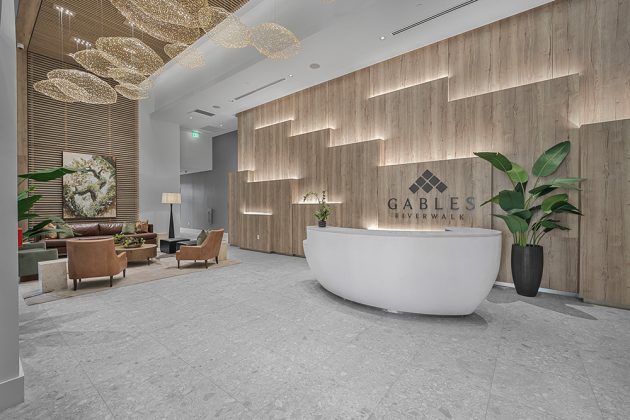
The main lobby at Gables Riverwalk is anchored by the work of Jacksonville-based artist Kristin Cronic, whose paintings also appear in the lower level and the mail room. Her botanical visual language sets the tone for the public-facing spaces.
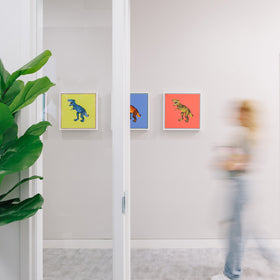
What sets this project apart is how the program continued past the rooms where art is expected. The leasing office is often the first place a prospective resident steps into, and possibly the first restroom they will use. A pair of works by Kristin Cronic carries the leasing experience forward, one placed inside the bathroom and one in a glass-walled office nearby, visible from the moment a visitor walks in. The artist’s voice is established before the conversation about leasing has even started.
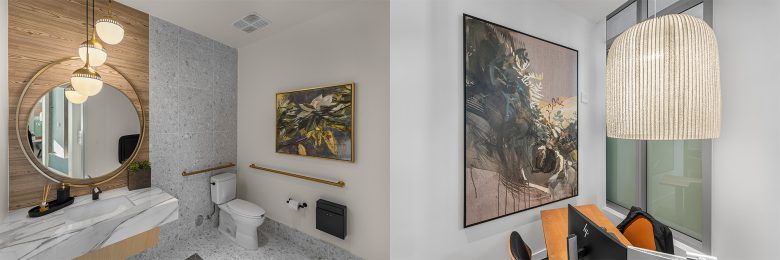
The leasing office bathroom at Gables Riverwalk features a work by Kristin Cronic, the same artist whose paintings anchor the main lobby. A second Cronic piece hangs in a nearby glass-walled office, extending the artist’s presence across the entire leasing experience.
The same thinking shaped the property’s other amenity zones, including the bar and lounge floor, where a flamingo motif anchors the design.
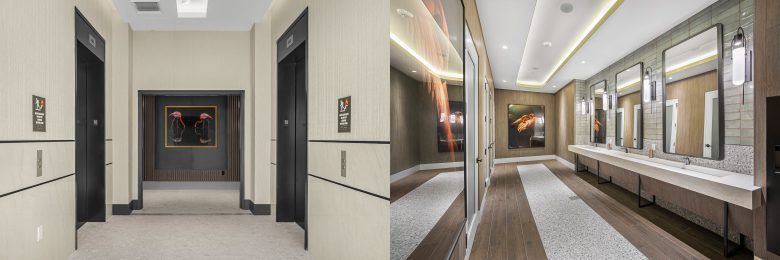
On the sixteenth floor at Gables Riverwalk, flamingo photography greets guests at the elevator landing and continues into the restrooms off the same floor, carrying the design language across the entire experience.
The theme begins the moment a guest steps off the elevator. A flamingo photograph greets them at the landing, the imagery continues through the bar and lounge, and it carries into the restrooms directly off the floor. The artwork narrates the guest’s path through the space, room to room.
The result is a property where the artwork is felt as much in the bathrooms as in the rooms designed to be photographed. Residents and guests feel the consistency, and the building reads as one continuous design rather than a series of rooms that happen to share an address.
The argument for artwork in public bathrooms is straightforward. A luxury property has been designed with intention in every room except this one. Closing that gap is one of the highest-impact moves an owner can make.
Bringing artwork into the bathroom extends the design language into a space that has always deserved it, without competing with what the design team has built. It gives the property a signature in a room most buildings overlook, at a cost that is modest relative to the rest of the FF&E budget.
The principle holds at every tier of the market. At Darby Townhomes in Sharon Hill, Pennsylvania, the leasing and management office bathroom is a small, simply finished room, and a single botanical work was enough to bring the property’s design story into it.
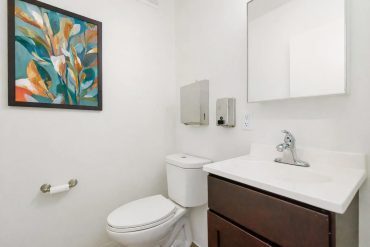
The leasing office bathroom at Darby Townhomes, where a single botanical work brings the property’s design language into the room.
When the bathroom is treated as part of the continuous design, the result is a property that feels complete from the front door to every room beyond it. The artwork makes that completeness possible, often at a fraction of the cost and time of the elements already in the room.
Treating the bathroom as part of the design is one of the small choices that end up shaping how a property is remembered. It’s a small consideration with a lasting effect, and one our team would be glad to help you think through on your next development project.
Written by David Dempsey, Director, Media Services & Content