Polly Shindler is a Hudson Valley painter based in Millerton whose color-filled paintings of windows, rooms, and landscapes capture small, everyday moments.
The oranges and reds look extra saturated in the October sun as we drive toward Millerton, New York. We pass through small towns, cornfields, and wagons filled with pumpkins for sale on the side of the road. It’s the height of fall in the Hudson Valley, and we’re on our way to meet painter Polly Shindler, who describes herself as a “color maximalist.”
When we arrive, Millerton is just as charming as I’d imagined. Main Street has its movie theater, local shops, and diner, and Polly’s house, just off the main road, looks like it could have come out of one of her window paintings.
As we step out of the car, the studio door opens and a fluffy white dog bounces down the front steps to greet us, though only after a quick assessment to make sure we’re good people.
Polly waves us in through the side door. Her studio sits right at the front of the house, so I ask if it was once a porch.
It was the living room.
“This would have been a nice living room, but instead, I needed a studio. So there we are.”
While my videographer gets set up, we chat about her morning routine. Polly reaches for her laptop to show me the crossword puzzle she completes every day. It keeps a running record of her times, including that morning’s, finished in 15 minutes and 48 seconds.
Before long, we’re talking about what I came to see: her paintings.
The Right Pink
From across the room, Polly’s paintings appear almost deceptively simple. Familiar subjects, defined shapes, and bold blocks of color. But up close, there’s far more going on. A green that reads as one flat color from a distance turns out to be a dozen different greens layered together, some brighter, some watered down, all sitting side by side.
Polly doesn’t hesitate to name her approach. “I’ve always been like a color maximalist.”
There’s no strict formula behind it. She works by feel, often pairing a bright color with something duller to see what happens. If a color isn’t working, she paints over it.
“If it’s the wrong pink, then I got to get rid of it, you know? I got to find the right pink. I got to find the right yellow.”
She admits she isn’t great at making choices. Instead, she’ll put everything on the canvas and start taking things away until she finds what she’s looking for.
Her newer paintings take that experimentation further. They’re botanicals built out of dots, which she associates with seeds, growth, and whatever might come next. She’s been using a set of acrylic markers, originally purchased for workshops, to work through different color combinations. She pulls them out to show me, almost like a box of swatches.
Some days, a painting starts with nothing more than a color she wants to use. “I’m like, I want to use fluorescent pink today. And where does it need to go?”
Paper mache mode
Before visiting, I’d spent some time looking through Polly’s website and Instagram. Among the paintings were these wonderful little paper mache objects, and I was curious about them. One of the pieces she’d recently posted is hanging on the studio wall.
When I bring it up, her eyes light up. She pulls over a shipping box and starts unpacking a collection of handmade objects.
There’s a pair of headphones, a ball of yarn, a horse, and a sewing machine. Some are ornaments, while others are closer to small sculptures.
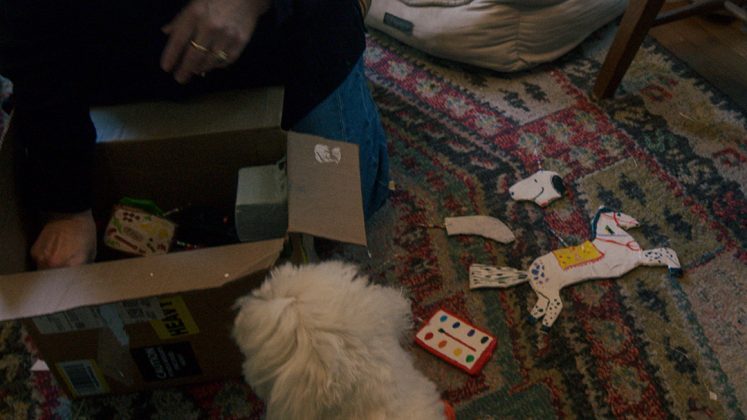
Ornaments and small sculptures from Polly’s paper mache collection, laid out on the studio floor.
She started making them during Covid, though she can’t quite remember the exact moment it began.
“I just started messing around… making something into a sculpture when I’m not a sculptor.”
She learned from YouTube, experimenting with cars, trucks, and buildings before moving into the objects she makes today. She also taught herself to quilt during that time.
“I learned to quilt during Covid. I mean, we were so bored, right? I was painting a lot, but I’m like… there’s more stuff to do.”
I ask how she decides what to make. “I think it’s just stuff that’s ubiquitous, you know. I’m making a list of the things I want to make for this coming year. It’s almost like an end of year list. What was great this year? What stuck out to me? It’s sort of like an annual roundup.”
An annual roundup you can hang on a tree.
Some of the ideas come from other people. Knitters order the yarn ornaments, and occasionally someone will ask her to recreate something specific. One customer wanted a paper mache version of a memorable dinner they’d had at a fancy hotel. Then they wanted nine of them to give as gifts.
So Polly made nine little versions of the same Italian dish. It’s funny, but it also says something about the way she works. She’s interested in the objects and experiences people attach meaning to, even something as ordinary as a meal.
And while the finished pieces have a playful, handmade quality, they’re more involved than they appear. Each starts with a cardboard structure, built up with newspaper and glue, then primed, sanded when necessary, and painted.
She sells them through the Wassaic Project’s holiday sale, local shops, and a gift shop in Greenpoint run by a friend from graduate school. She also teaches the process through occasional workshops.
Part of the appeal is that they’re accessible.
“People can buy this, and it’s not a huge lift. You know, paintings are different.”
And with the holidays approaching, she’s making more of them than ever.
“This part of the year is like when… some people go into soup mode, I’m going into a paper mache mode. So it starts when the weather starts to change.”
Judging by the box she just unpacked, paper mache season is well underway.
Becoming a colorist
Polly grew up in Hamden, Connecticut, just north of New Haven. Her father is a painter and taught her things when she was young. She was also the kid in class everyone asked to draw something for them.
Still, art wasn’t the plan.
She went to UMass Boston to study history, writing papers she now admits she can’t remember much about. She took a printmaking class almost as an indulgence, then signed up for another.
One of her classmates worked on The Watermark, the university’s journal of poetry and photography, and asked to feature one of Polly’s prints on the cover.
“I went into the bathroom and like, screamed.”
She still has the publication, dated 2000, and pulls it out to show me.
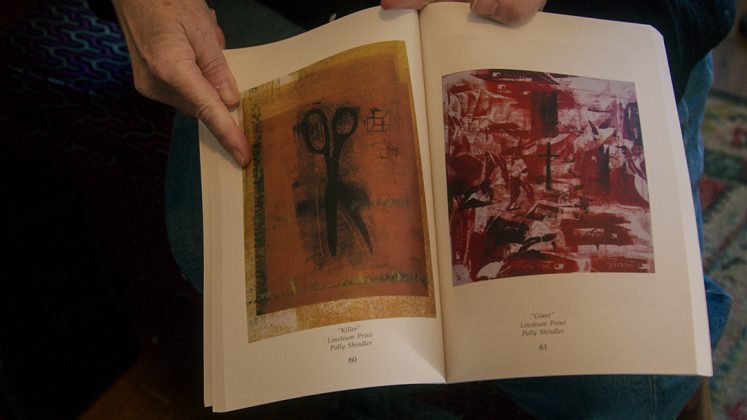
Two of Polly’s linoleum prints in The Watermark, UMass Boston, 2000
It was also her printmaking teacher who first described her as a colorist.
“My teacher called me a colorist and I was like, I don’t know what that is.”
It’s hard to picture that now, sitting in a studio surrounded by paintings where color is such an important part of the work.
Polly never took a painting class as an undergraduate. She taught herself, eventually earning her M.F.A. at Pratt Institute.
Her work has also found its way into publishing. A series of bed paintings she made during Covid led to book cover commissions, including Ochtendmens, the Dutch edition of Katherine Heiny’s Early Morning Riser.
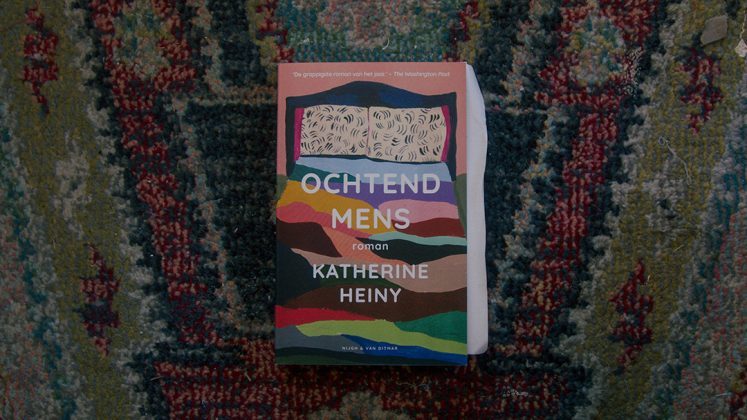
Ochtendmens, with cover art by Polly Shindler.
For Polly, that part is personal. “I love reading so much, I’m like, oh, it’s so cool to be able to go to a bookstore and see your book.”
On Purview
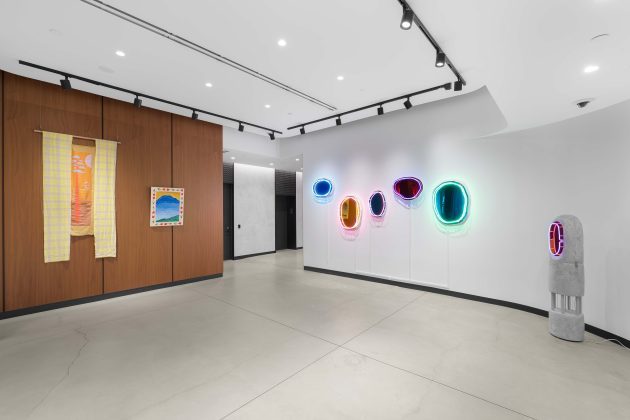
Installation view, Purview, Gallery 85. Blue Mountains by Polly Shindler.
Three of Polly’s paintings are part of Purview, an exhibition at Gallery 85 curated by Sarah Mohrman. The exhibition brings together six women artists with ties to New York, including Polly’s former Bushwick studio mate, Esther Ruiz.
When Sarah talks about Polly’s work, she uses a word I wouldn’t have expected.
“With Polly Shindler, the exhibition becomes much quieter.”
That’s not how I’d describe someone who just told me she’s a color maximalist. But looking at the paintings, I understand what Sarah means.
The quiet is in what Polly chooses to paint, and the color is how she gets you to notice it.
Sarah describes the work as a way of looking at small, often overlooked moments of everyday life. Polly simplifies these scenes, removing details while keeping enough of what’s familiar for us to recognize them.
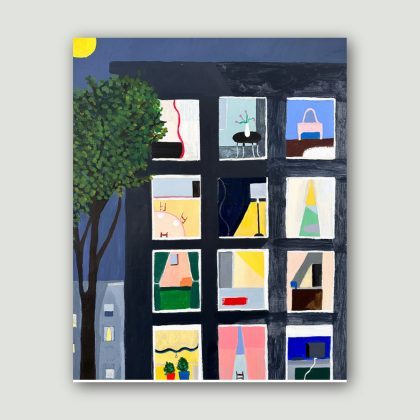
Polly Shindler, Full Moon Apartments, 2024, Oil and acrylic on canvas, 20” x 24”
The painting Sarah keeps coming back to is Full Moon Apartments, a 2024 work showing an apartment building at night. Each illuminated window offers a different glimpse inside: a vase of flowers on a table, a lamp, curtains, potted plants. Every room has its own colors and arrangement.
“I especially love Full Moon Apartments because you’re looking at all of these separate illuminated windows and imagining the individual lives happening behind them.”
The building itself is almost a grid, with windows dividing the canvas into smaller compositions. There’s something appealing about that balance between the geometric structure of the building and the imagined lives inside it.
She began as an abstract painter and gradually challenged herself to paint recognizable subjects, finding ways to bring what she liked about abstraction into those images.
Windows became a recurring subject. Their frames offered a natural structure for arranging shapes and colors, while giving her the freedom to imagine what might be happening on the other side.
She’s painted enough of them that her first solo exhibition at Deanna Evans Projects was titled Windows.
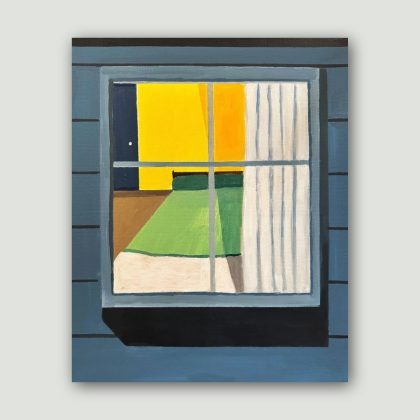
Polly Shindler, Bedroom Window, 2025, Oil and acrylic on canvas, 16” x 20”
Bedroom Window, from 2025, takes us closer. Instead of an entire building, we’re looking through a single illuminated window at a green bed against a warm yellow wall, with a white curtain pulled to one side.
Polly tells me that most of the rooms she paints are imagined. But there’s enough that’s familiar that you can almost picture yourself inside them.
“It’s just pointing it out and saying, we all know this thing, right? And I just want to show it to you in a different way.”
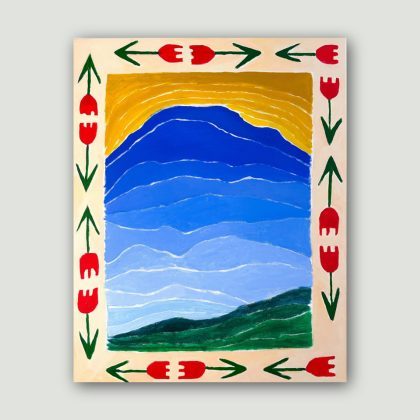
Polly Shindler, Blue Mountains, 2025, Oil and acrylic on canvas, 24” x 30”
The third painting, Blue Mountains, also from 2025, shifts from interiors to the landscape around her home in Millerton.
Layers of blue mountains sit beneath a gold sky, surrounded by a painted border of red tulips. It’s bold, decorative, and noticeably different from the window paintings, though the interest in framing and layering is still there.
Polly isn’t sure she’d be painting landscapes at all if she hadn’t moved upstate. The views around her have become a regular source of ideas. “You turn a corner. You’re like, I’m on a mountain. And I can see for a mile.”
The tulip border is something she’s been exploring in her recent work. Rather than relying on a separate physical frame, she paints one directly onto the canvas, giving herself another place to experiment with color, pattern, and depth.
It’s one of the things I like most about her paintings. Even when the subject is something recognizable, like a mountain or an apartment window, she doesn’t feel obligated to depict it exactly as it appears.
There’s room to rearrange things, simplify them, and choose a different pink if she wants to.
Art outside the gallery
Gallery 85 sits inside the lobby of an office building in New York City. Unlike a traditional gallery, many of the people who encounter the exhibition are simply walking through on their way to work.
I’m curious what Polly thinks about showing her paintings in a space where people might not have planned to look at art at all.
She likes the idea. “It’s nice to show your work in a space that is, not designed necessarily for art so that other people will come into contact with it.”
Most of her paintings are exhibited in galleries, where visitors have made a deliberate choice to see art. An office lobby changes that relationship. Someone might pass a painting every morning and one day finally stop to look.
She’s had meaningful responses to her work from people she never expected to hear from, and she likes not knowing who might connect with a particular painting.
When I ask what she hopes someone might take away from seeing her work during an ordinary workday, she says she hopes it can offer a change of pace, even briefly.
“It would create like a really nice respite from everything else that’s going on in your purview.”
She brings up Alain de Botton’s Art as Therapy and the idea that the things we’re drawn to can sometimes balance out what’s happening in our lives.
Someone whose days are quiet and routine might want to come home to a room filled with color. Someone surrounded by noise and activity might look for something calmer.
It’s a good way to think about art in shared spaces.
Polly puts it more simply. “I can’t do what they do… So they should benefit from something that I’m doing.”
A lived-in life
As with the other artists I’ve interviewed for Purview, I ask Polly what the exhibition’s title means to her.
“It’s like, this is my realm.”
We talk about what she said earlier, about painting things people already know and showing them in a different way.
Maybe that’s part of her responsibility as an artist, she suggests. To make reminders of what’s around us, and to get people looking again at the little things they’ve stopped noticing.
It makes me think back to the paper mache objects she unpacked earlier. The headphones, the ball of yarn, even the little Italian dinners. They’re all things people recognize, and she made them worth looking at again.
Before we leave, Polly has one last thing to show us: a little wizard costume she’s made for her dog.
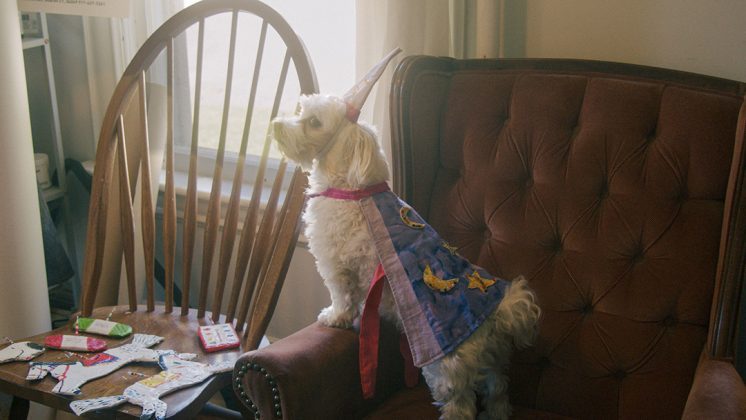
One last surprise from Polly’s studio: her dog modeling a wizard costume she made, surrounded by a few of her handmade papier-mâché pieces.
He sits perfectly still for the camera, which seems to surprise Polly more than anyone.
For the record, she tells me the studio is unusually clean today. She describes herself as past type B, somewhere closer to type F, and someone who needs things a little upside down to get through the world. She doesn’t worry much about keeping everything looking perfect.
“I don’t have shame in clutter. I want to live a lived-in life. I want there to be evidence that I live here and I can be a mess, but that’s okay.”
Where to see it
Blue Mountains (2025), Full Moon Apartments (2024), and Bedroom Window (2025) are featured in Purview at Gallery 85, curated by Sarah Mohrman.
Polly is also preparing for a future solo exhibition with Deanna Evans Projects, with dates still to be announced.
See more of Polly Shindler’s work at pollyshindlerpainting.com, and learn more about Purview here.
Read more about Rebecca Bird, another artist featured in Purview.
Read more about Esther Ruiz, another artist featured in Purview.
Written by David Dempsey, Director, Media Services & Content