Esther Ruiz is a New York artist based in Ridgewood whose neon sculptures explore time, space, and the unknown through concrete, glass, mirrors, and light.
On any given afternoon in August, walking the worn industrial blocks of Ridgewood, you’d pass a number of artist studios hidden behind graffiti-drenched walls and the loading dock doors of unassuming buildings. This visit begins the same way. Sculptor Esther Ruiz sends a text: “meet me at the door circled in the screenshot.” I’m relieved a screenshot was provided, or I’d have walked right past it.
We’ve caught Esther on one of her last days in this studio. She’s planning to pack it up after we leave, but you wouldn’t know that stepping inside. Instantly you’re met with the warm glow of her works hanging on the wall and displayed on stands in the corner. A table of unique earth and rock finds is spread out to the left. To the right, large modular sculptures sit on a shelf. Underneath, a doorway leads back into the woodshop.
Around the studio, I see several bodies of work up close, some older, some from this year. I ask her to walk me through them.
“I work simultaneously on several bodies of work. Some of them I started over a decade ago. Some of them I started a few months ago. I kind of float between them when I get bored, or when I want to do something new. They all refer back to one another with materials.”
Even the crates she builds to transport the work are beautiful, each one a custom shape, held together with its own color of tape. We first saw these when they arrived at Gallery 85, and every one of us made a point of saying how cool they were. The woodshop in back is where many of the crates are made, along with much of the sculptural work itself.
“The freestanding sculpture in that show was cut in here and sanded and assembled. And then when they’re, like, glued together, I like, I use a grinder on wood, which is like not what it’s made for, but that happens in there and it gets really dusty so I built this enclosure.” The colors of the tools and the plastics, the tubing, the wire, the cables. It’s like a home improvement store fever dream in the best way. What you don’t see, once you’ve absorbed everything else, is a window, or a clock.
“I come in here and I don’t know what time it is. I can be in here for hours if I don’t have my phone on me. And I think that kind of in a way, it has to do with the work.”
She doesn’t see that as a drawback. The room is part of the work, too. “I think it plays with the work. These things, I’m really interested in time and space travel, and being in this time warp, you would have no idea.”
Then she names the room itself: “This is my void.”
How it all got folded in
There’s an old Star Wars game console on the table next to me. The cartridges are still in it, sitting among the wires and tubing. It looks like a piece of childhood, but it fits in here. Esther’s interests tend to find their way into the work.
First I want to know how any of this started. Why neon?
“When I first moved here I was working odd jobs for a couple of artists, and then I applied to a Craigslist ad that said studio assistant. I assumed it was going to be an artist, and it ended up being a neon shop. And it just was perfect.”
A hell of a way to find a medium.
“I know, super Craigslist.”
It turns out that’s just part of the pattern.
“I moved to New York and concrete was added to the mix. Then I started working in a neon studio and neon was added in. Every time I have a new day job or interest, those things all get folded in.”
Her materials come from the jobs she’s had and the rooms she’s worked in. The concrete showed up first, in a basement studio.
“When I first moved to New York, I had this dingy, lower level studio. It was awesome, but it was concrete everywhere. I think I bought concrete to patch a hole.”
What she did with it came out of a class. Esther grew up in Houston and studied studio art at Rhodes College, a small liberal arts school in Memphis with six students in her major. The curriculum was built on the classics, so she took religious studies, math and, in her final semester, geology.
“We studied core samples, which are cylindrical pieces of Earth that they drill out of the Earth, and they basically study the history of the land by looking at the layers. So I was making my own.”
She points to a group of rough concrete cylinders on the left side of the studio, built up in uneven layers with small pieces of colored material breaking through the tops.
“Those are actually from that time, like 2011. Those were four feet tall and then some of them broke. And my professor said, oh, the top is actually, to me, the most fascinating part.”
“So then I just started making the tops. I kind of see them as landscapes, like horizon lines.”
A broken sculpture and an offhand comment led her to a form she still makes fifteen years later. Then the Craigslist job added neon on top of it. The material was new, but the color wasn’t.
“I was using fluorescent plastics. And then I got that job and I was like, oh, I could just put neon in here.”
I know neon from neon signs, but I don’t think I’ve ever thought about what’s actually making the glow. She picks up a tube to show me.
“It’s neon, a gas, and it’s trapped inside this tube, and then they electrify it with a transformer.” … “Neon’s in the air we breathe. It’s like helium. It’s like a lot of other gases that are in the air.”
Which is the same logic as the shells and the stones on her table. The material is already here. Somebody pulled it out, sealed it in glass and ran current through it until it was the only thing in the room you could look at.
A hoop, a loop, a blob
The wall works are called Wells, and they started in a sketchbook during a stretch when nothing else was working.
“They started out from the sketchbook. I was stuck, basically. It ended up being just a bunch of shapes, and I was like, I don’t know what I’m doing. And then I filled one in and I was like, oh, it kind of looks like a neon tube.”
That was around 2014, a few years into New York.
“I was in a place where I didn’t know what I was doing in the studio, and I was sort of new in my practice. I think I had been calling myself an artist for all of three or four years. So I think there’s something about identity there, like being a little lost.”
She comes back to it a minute later and says it simply. “It was a dark place in my life. I was just really lost.”
What came out of it was a decision about what these objects would refuse to hold.
“There was something about it being an empty neon sign and not having any text or anything illustrative. It’s just a hoop, a loop, a blob.”
An empty sign. A shape that does everything a neon sign does to a room but tells you nothing.
I point out that, for something that came out of a dark place, the pieces are awfully bright.
“I know, cheesy.”
She’s been making them for twelve years. Five are in our show, ranging from Well XXXVIII to Well LXI. The materials have stayed consistent: acrylic mirror throughout. What’s changed is everything you can’t see. In the newer works, she embeds the transformer wires and the hanging hardware into the piece itself.
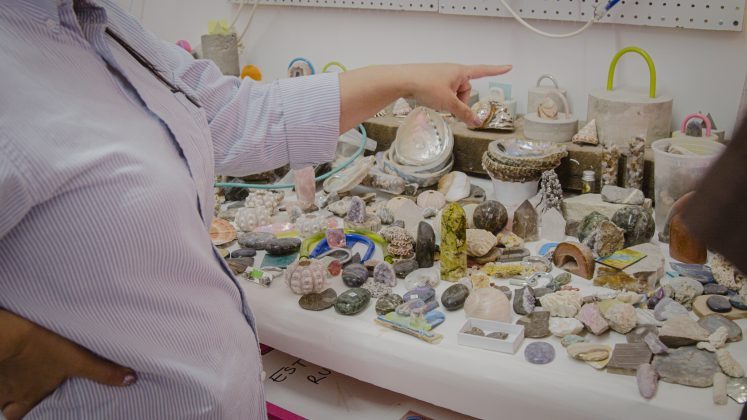
Esther walks me through the collection table, pointing out a few rare finds among the more common ones.
Across the studio there’s a table loaded with everything that isn’t glass or concrete. Stones, shells, minerals, things she’s had since childhood.
“These are from a science museum gift shop that I’ve had for years. I want to say they’re probably from NASA, from when I was a kid.”
She hands me an abalone shell, then finds something better.
“This is part of an asteroid. I don’t know where it landed. They covered it in resin, but it’s a small sliver. It looks like amber, almost. That’s just an element that’s floating around in space.”
Concrete, glass, gas, and a rock from space. They all have a place in the work.
“What I’m interested in is the man-made versus the natural, and then concrete, which you see everywhere, super industrial. I like that tension. Even the tension between glass and concrete is interesting to me. Like a delicate relationship.”
Made to disappear
I’d assumed she bent all of the neon tubing herself. The designs are hers from the first sketch, but the glass bending happens at a neon shop.
“First I start out with a sketchbook and I make a drawing, and then I translate it into Illustrator. And then I send it to a neon shop.”
She spent years working in neon, so she knows the process well. The shop prints the drawing to scale, bends the glass, and fills the tubes. Once they come back, the rest is hers. She handles the electrical work, builds the backs, and makes the small standoffs that hold the glass off the wall. She started making those because she hated the ones the industry sold.
“I hated the way they looked, so that’s why I started making my own.”
I ask what’s wrong with them. “I don’t want to say ugly when they’re off.” … “I think they’re ugly.”
Then she explains why those small details matter.
“I think they’re made to disappear. Some of these were like empty signs to me, or like voids. So I was really paying attention to the little things, the stands and the wiring and how things function, because to me those things stand out.”
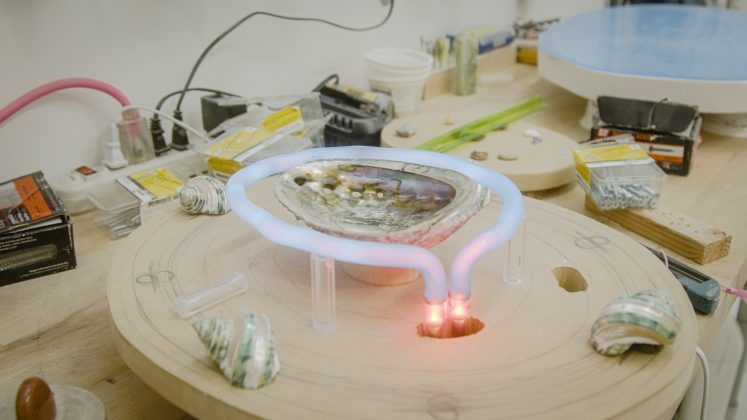
A lit tube in the studio, held off the surface by the standoffs Esther designs herself. The red glow at the base is the electrodes.
On Purview
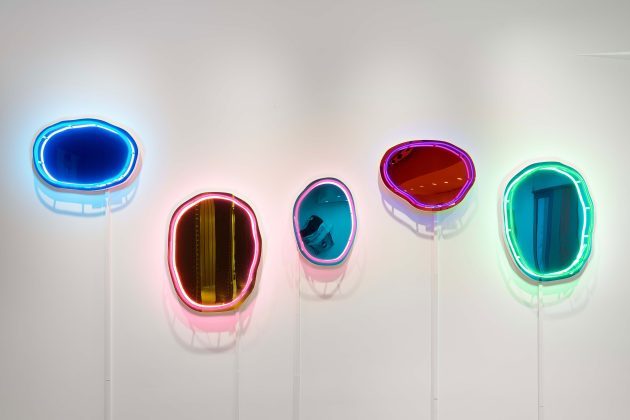
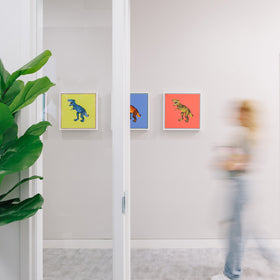
Installation view, Purview, Gallery 85. Five works from Esther Ruiz’s ongoing Well series.
Five Wells and one freestanding sculpture sit at the end of the long wall at Gallery 85. Sarah Mohrman placed them there on purpose.
“Ruiz takes us in a completely different direction. Her sculptures draw from Minimalism, geometry, science fiction and imagined landscapes. They’re very precise objects, but there’s also something playful and almost otherworldly about them.”
Sarah wanted the work to bring something different to the rotation. The neon, the geometry, and the mirrored surfaces give the pieces a presence that changes as people move through the gallery.
“Her Well works combine neon and mirrored surfaces, so they actually change the environment around them. The light spills onto the wall, the mirror picks up the viewer and the room, and suddenly the artwork isn’t just something you’re looking at. You become part of it. That felt particularly important for Purview because the experience of the work changes depending on where you’re standing and how you move through the gallery.”
That is why the placement matters. At the end of the wall, the work catches people as they move through the space. It holds the room, but it also keeps changing with the room.
Esther describes the same effect from the artist’s side, in more practical terms.
“The newer works I call Beacons. They could be a beacon of light, and they draw you in. I think that’s why people use neon lights in stores and bars, because they draw you in. And then as you get closer you see that there are these reflections, reflecting the other work, and it changes the other work, and it changes the way you look at them and the way the space looks.”
Across the wall, the colors run blue, yellow, blue, red, and green. Gallery 85 sits in the lobby of a Google building, so most people encounter the work while moving through the building. Esther had to make new pieces for the rotation after the works originally planned for it went to another exhibition.
“I had other ones go to a show, so I had to make new ones to replace them. And it was like, should I go more Google?”
At the corner is COMMU-2 (Guidepost), which brings several of those materials together: neon, acrylic mirror, cement, gypsum, rubber, string, electrical components, and paint. The title comes from Esther’s interest in space programs and communication devices.
“When NASA sends satellites, they call them communication devices. So this is a play on that, like a pod containing information.”
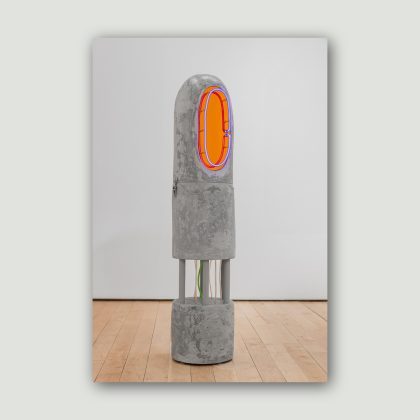
Esther Ruiz, COMMU-2 (Guidepost), 2025, neon, acrylic mirror and tube, MDF, cement, gypsum, rubber, string, electrical components, paint, 12″ × 59″
The hardware is part of the work, too. Walk up to any of the pieces and you can see the supports under the glass, the cords running down the wall, and the wiring leading to the floor. In a lobby where most systems are meant to disappear, Esther lets the construction remain visible.
The rotation brings together six women artists with connections to New York, including Esther’s friend Polly Shindler.
“It’s nice to be in a show with other New York artists, especially female artists, because most of us probably know each other, and if we don’t know each other one on one, we’ve known of each other’s work.”
When I ask what she sees in the finished rotation, she reads it the way a curator would.
“There’s a lot of color play, and the materials we use, and Polly’s landscapes. Oh, that’s what Polly is thinking about, that’s what Polly is looking at. Or there are the window fabric works, and it’s like, there’s a window, there’s a portal. It’s interesting to see what we’re all thinking about and looking at and reflecting out into the world.”
The breath
Gallery 85 is a gallery in a lobby. Most people pass through on the way to a desk. At ATP, we place art in spaces like this all the time, so I asked Esther how she thinks about her work being seen by people who did not come specifically to look at art.
“Every time the work is shown, the venue changes it. And the audience changes it also.”
In a corporate setting, she says, the work can be “almost like a breath. A moment for the people who interact with it to take a break visually and mentally from what they’re doing.”
Then she puts it in terms we explain to our clients often.
“Not a gift, but something for the people who work there, to clear their minds or spark some kind of creativity. I feel like the people in those buildings are doing creative work in some way.”
Esther also knows the Google building from the other side. Years ago, while working as a fabricator, she installed neon in the offices across the street.
“My friend who works there sent me photos. He was like, hey, nice work at the place I work.”
I asked whether it felt strange to see work that began during a difficult period in a corporate space. She didn’t hesitate.
“I don’t have negative feelings about it. I like seeing my work in different places. Because they’re mirrors, you never know what they’re going to do in a space and what they’re going to reflect.”
She has also let go of deciding exactly what the work should mean.
“I’ve let go of being prescriptive about what they are and what they mean, because they meant something to me over ten years ago, and now they mean something else to me.”
The edge of what we know
I usually end a studio visit by asking the artist what the exhibition title means to them. When I ask Esther about Purview, she takes a moment. A few minutes later, she brings it up herself.
“The range of what one is able to perceive or understand. I think that word kind of can define, or not define, what I’m interested in as a whole. This range of ideas and space, and kind of not being able to grasp it.”
Later she puts it more directly.
“What my work is thinking about is the ungraspable, or the unattainable. The void, the vastness of the universe. The edge of what we know, and expanding beyond that edge.”
Then the other half of it.
“And then your interior monologue. This interior, exterior. What’s close and what’s so far reaching. Purview’s a good word. What you know, what you don’t know. That’s what I’m interested in.”
The Star Wars console from the beginning is part of the same picture. Esther likes science fiction because it gives her different ways to think about space.
“I really love sci-fi films, mostly because I like to see different interpretations of space.”
She brings up Tatooine’s two suns and the blue haze around the sun on Mars. “Thinking about that just really blows my mind.”
Put it together: a geology class, an asteroid in resin, a shell, concrete, glass, gas, and neon. The materials change, but the question stays the same: what do we know, and what is still outside our view?
Where to see it
The studio where I spent the afternoon no longer exists. She packed it up the week after we left.
“I was just in a bunch of shows, so I’m kind of taking a breath.”
The next things are already lined up: a show at a college in North Seattle, where she once studied, and work in Miami at NADA.
Before I left, I asked if she had anything else to add. She turned the question toward the rest of the rotation.
“I’m interested to see what all the other artists say.”
Well XXXVIII, Well XLVII, Well XLVIII, Well LX, Well LXI, and COMMU-2 (Guidepost) are on view at Gallery 85 as part of Purview, curated by Sarah Mohrman.
See more of Esther Ruiz’s work at estherruiz.com, and learn more about Purview.
Read more about Rebecca Bird, another artist featured in Purview.
Written by David Dempsey, Director, Media Services & Content