Written by Sarah Mohrman, Director of Curation
In recent years, the conversation around health in senior living has expanded beyond clinical care to include something more holistic: environment. Increasingly, developers and designers are recognizing that wellness is shaped not only by medical services or amenities, but by the spaces people inhabit every day, what they see, feel, and experience. Within this shift, art stands out as a powerful way to create an immediate and lasting positive impact.
From hospital systems to affordable housing, research continues to show that art, especially when integrated into the built environment, can play a measurable role in improving physical, emotional, and cognitive well-being. The World Health Organization has identified the arts as a key contributor to health, linking arts engagement to improved mental health, reduced stress, and enhanced social connection across populations.
But what does this look like in practice? At Terry Manor, a senior living community in Los Angeles, art is not treated as an afterthought. The carefully curated program, developed by ATP.art, was conceived alongside the building’s renovation to ensure that residents would experience an immediate sense of uplift upon completion and every day thereafter.
The Science Behind Art and Wellness
We have long understood that art has healing properties, but today the data is catching up.
Research from institutions including the Mayo Clinic and the National Endowment for the Arts shows that engaging with art, even passively, can:
- Reduce stress and anxiety
- Improve mood and emotional resilience
- Stimulate cognitive engagement
- Create a sense of calm and optimism¹
A 2019 World Health Organization (WHO) report further reinforces this, finding that the arts can help “to prevent the onset of mental illness and age-related physical decline” and assist “in acute and end-of-life care.”²
Similarly, in a recent New York Times article, An Overlooked Prescription for Happiness, art is described as the “fifth pillar of health alongside diet, sleep, exercise, and nature,” highlighting that creative engagement has “tangible effects on our mental and physical health.”³
Longitudinal research also points to lasting cognitive benefits. Writing in Nature in 2018, UCL researchers found that visiting museums or attending live performances was associated with slower cognitive decline over the following decade among adults aged 52 to over 90. A follow-up study published in 2020 in Epidemiology & Community Health reported that these same activities were linked to a lower risk of dementia over a 12-year period among adults aged 50 and above.⁴
Long-term studies in arts and aging show that older adults who engage with the arts experience better overall health outcomes, including fewer doctor visits, reduced medication use, and improved well-being.⁵
The takeaway is simple but powerful: art benefits us, even when we are not consciously engaging with it.
A Case Study: Terry Manor
At Terry Manor, art was approached from the outset as part of the wellness strategy, not as a finishing touch.
The curatorial program, which I developed, centers on themes of biophilia, nature, and serenity, drawing from both contemporary wellness research and historical movements such as Impressionism.
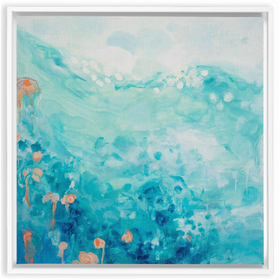
At the heart of the collection is Kristin Cronic, whose work anchors the building. Her paintings explore the relationship between humans and ecological systems, using trees and plant life as metaphors for resilience, connection, and growth. Cronic describes nature as offering “quiet wisdom” about how we relate to one another and the world around us.
That philosophy translates directly into the resident experience. Her works do not demand attention, they invite it. They, along with the other works in this collection, create moments of pause throughout the building, bringing the essence of the natural world indoors so it can be experienced daily. Artists such as Julie Lynch and Danushka Yonali Abeygoda extend this visual language through abstraction, atmosphere, and harmony, creating a cohesive environment that feels both grounded and expansive.
The result is not simply a collection of artworks. It is a living system designed to support wellbeing.
Why This Matters for Business
There is an important dimension that is often overlooked: this is not just good for residents, it is good for business.
In residential housing of any kind, the resident experience is directly tied to performance. Properties that invest in the environment and services consistently see:
- Higher resident satisfaction
- Increased retention and lease stability
- Lower turnover costs
- Stronger community engagement
Art contributes meaningfully to all of these outcomes.
When a space feels calm, intentional, and thoughtfully designed, people stay longer. They feel more connected. They engage more deeply with their surroundings and with each other.
A Shift in Perspective
If we accept what the research tells us, that art can improve mental health, reduce stress, and enhance overall well-being, then its role becomes clear.
Art is not optional. It is not ornamental. It is one of the most accessible and scalable ways to create environments that truly support wellbeing.
Footnotes
- Mayo Clinic, The Intersection of Art and Health: How Art Can Help Promote Well-Being
- World Health Organization, What is the evidence on the role of the arts in improving health and well-being? (2019)
- New York Times, “An Overlooked Prescription for Happiness” (2026)
- University College London studies published in Nature (2018) and BMJ Epidemiology & Community Health (2020)
- Gene Cohen et al., National Endowment for the Arts–supported research on arts and aging; see also NEA and Lifetime Arts evidence summaries