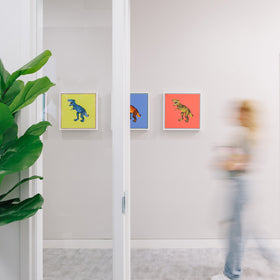
We’re all guilty of it. Walking past installed artwork that feels generic and is just there to fill the space. This is why we intentionally selected photography unique to the area for Gables Riverwalk in Fort Lauderdale, Florida. Our goal was to reflect the authenticity of Florida back to the residents who will see it repeatedly, in motion.
Even James admits he falls into that same habit. “Even as an image-maker I’m guilty of passing by installed images in common spaces and not thinking too deeply about where they come from or what the story is behind them. Many times it feels like just some careless installation designed to take up space.” That’s exactly what we wanted to avoid here. “However, this is a carefully selected image from a body of work about living in a subtropical environment and speaks to our relationship with local foodways.”
James Jackman is a photographer raised in Boca Raton, FL, with a fairly typical suburban experience. Despite that upbringing, James, now based in Miami, has a sharp eye for spotting the kinds of details and scenes most people pass right by, then amplifying them through his lens. Having studied photography at Savannah College of Art and Design in Savannah and briefly at their Hong Kong campus, James says, “I’m interested in how we interact with our environment. I especially love to photograph those who work with nature (farmers, wine makers, etc.).” He’s always looking for details that feel unique to a place. Patterns that repeat. “I’m also looking for people who seem to be focused on something, like their work or a view of the surrounding landscape.” See an example of what his eye catches below:
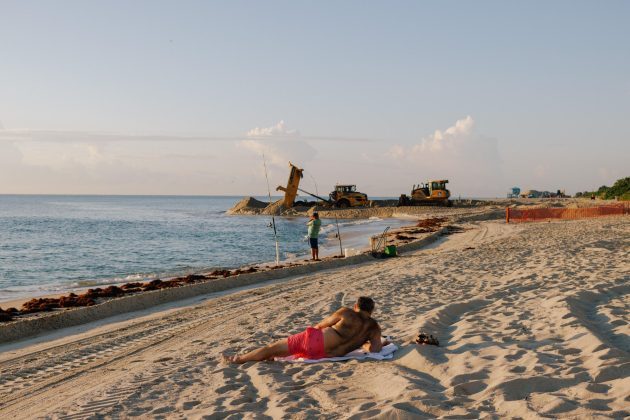
James looks for scenes where the foreground and background tell different stories at the same time. “Versions of this scene are kind of what I’m chasing all the time.”
For the Gables Riverwalk spa corridor, we presented the design team with the idea of a large wallcovering that fully wraps the space. Wallcoverings shift a corridor fast because they change the entire field of view. Done right, they make a transition space feel intentional, not like leftover wall.
The image needed to carry residents through the short corridor and introduce them to the peace and tranquility of the spa area of the property. That same feeling had to guide them back out with ease. This is why we brought in James. Gables’ goal was a biophilic approach, so we wanted to bring nature into this section in a way that felt local, not generic.
To describe James’ image: “Scientifically speaking it’s a photograph of a Monstera deliciosa plant growing in a special place in Boca Raton.” But there’s an even deeper connection to the idea of nature and home. “I’m quite close with the family that lives on the property where that plant is growing. Some years ago I made a point to photograph as much of the goings ons there because I loved how they lived in this ecosystem. The mahogany tree that the Monstera is growing in has since been cut down and I have a small cutting from it growing in my apartment.”
This is also why residential placement matters so much. “Images affect us differently depending on how we encounter them. There’s a real psychological impact that deepens with repeated exposure—especially when it’s something we see every day.” In a residential setting, he points out, people “don’t necessarily choose the images they live with, the way they would in a gallery or their own home.”
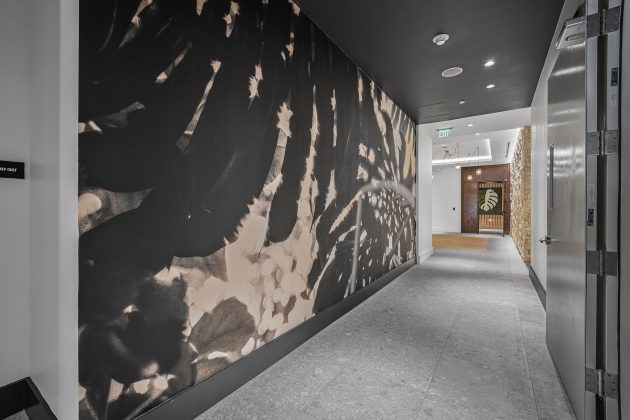
James Jackman wallcovering at Gables Riverwalk. A Monstera photograph scaled into a full corridor wallcovering, guiding residents into the spa with a calm, place-rooted image.
This is where ATP connects the dots. We help a client visualize what an unfinished corridor can become, and we work closely with artists to translate their work into something that can live architecturally, at scale, and still feel true to them. For James, this was a first. “This is the largest print of my work ever, so I’m quite happy with the results!” Over the course of a few days, the image was adjusted to the exact wall dimensions, printed as a full wallcovering, and installed on site. The impact is immediate. The corridor stops feeling like a pass through and starts feeling like a transition, a space that sets the tone before you even enter the spa.
There’s another layer to why working with James made sense for us. He wasn’t just the artist for this wallcovering. He’s also been behind the camera documenting some of our early property installs, which says a lot about how we think about the work as a whole. We want artists’ work to live well in the space, and we also want it captured well, because the way a piece is installed, lit, and experienced in context is part of the story. Good documentation respects the artist and it helps clients see what’s possible.
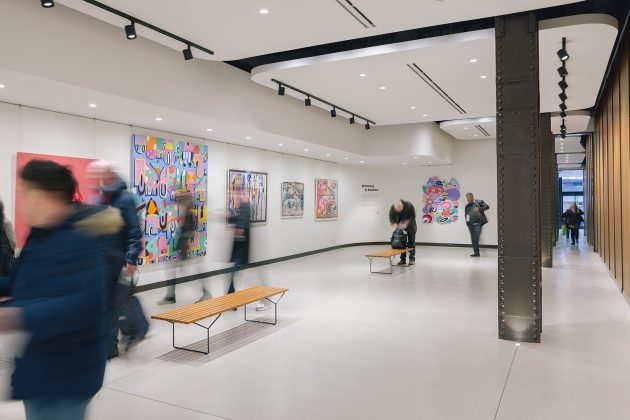
James Jackman photographed Gallery 85’s first installation, helping define how the space looked and felt in its earliest days with an eye for atmosphere, pacing, and the way people encounter art in space.
That’s the bigger point here. When photography is selected with intention, scaled thoughtfully, and placed where people will actually live with it, it changes the feeling of a building. It becomes part of the resident experience instead of background. And for artists, it’s proof that the work can expand into new formats and still stay true to where it came from. This installation is local, it’s personal, and it’s built to hold up over time, which is exactly what we want more of in residential spaces. That’s when it stops being décor and starts being part of the property.
Written by David Dempsey, Director, Media Services & Content