Art rotations and exhibitions are a lot like the life cycle of a flower. Each stage brings a visible change. Seed to stem to leaf to bloom, then back again. An art rotation works the same way. You introduce new works into a space, and the room shifts visually. The people who move through it notice. It keeps the environment fresh and gives the brain something new to take in during a routine day.
A chilly day in Manhattan feels like a big juxtaposition to talking about Alissa’s paintings, but that’s exactly how it was, welcoming her into Gallery 85 to see and discuss the four pieces she has on view in Contours.
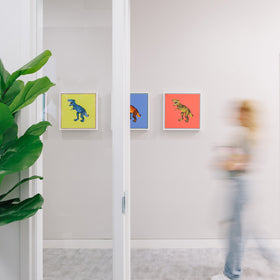
With the temperature slightly above freezing outside, a familiar warmth arrived when Alissa walked in, phone out and recording, because this was the first time she had seen her work hanging in the show. Contours is the current exhibition running at Gallery 85, a gallery in Chelsea, New York, anchored just before the elevator vestibule for the commercial building at 85 Tenth Avenue. It is part of an extended art rotation and exhibition program between ATP.art and the building’s owner, Related.
Alissa became part of the ATP.art artist community through one of our most common outreach strategies. She saw an ad while scrolling Instagram that stated ATP.art was looking for artists interested in selling limited edition prints through a new program we were launching. Alissa was selected as one of the artists, and through that, she caught the eye of Isabelle George, the ATP.art curator responsible for Contours. Sometimes that is how it works. You apply for one opportunity, and your work gets seen for another. It’s a full circle moment that says a lot about how these programs can work in the real world: an artist finds us through an open call style entry point, and that same connection can lead to client pitches or, in this case, a physical exhibition.
Alissa has an interesting story. After being a jewelry designer for 20 plus years in the city, when COVID happened, she decided to stop and redirect her life. “I redirected my life in a way that felt meaningful. That felt like something I was supposed to do. And that was art, that was painting. I’ve always wanted to paint. I’ve always been painting, but I never took it seriously. It’s always been a side thing that I did when I had a little bit of time. When Covid happened, I took a break. I had a baby, I stopped working full-time, and I focused on what made me happy.” Later, when asked what advice she’d give, she adds: “It’s hard because you can easily say, just for it. Do what your heart wants. Thats not the reality of this world, though. You need to pay your bills. You have children to take care of. I was fortunate to be able to follow my heart because I had a family that was able to support that.”
Family shows up as a steady thread in Alissa’s relationship to art. Her parents used to take her and her brother to museums every week when they were younger. She remembers seeing exhibitions and famous works like Starry Night, and in one memory, she recalls reaching out and touching the work as a child. When a custodian reprimanded them for the forbidden act, her mother responded that she was intrigued by it. That kind of curiosity stuck. Her grandfather also taught her how to paint, building her first easel and her first palette when she was ten, both of which she still has today. He was an artist himself, and he taught her how to use brushes, how to work with oils, and how to think about technique.
Alissa’s piece, My Lauretta, is an ode to her mother. “It’s a kind of love letter to her. It reminds me of her. It’s very much her- dark, moody green with wildflowers and Queen Anne’s Lace. It’s a little vintage in a way.” My Lauretta was the first piece in which she used her palette knife technique, scraping imagery out from the color below. It feels like a turning point within the work, both technically and emotionally.
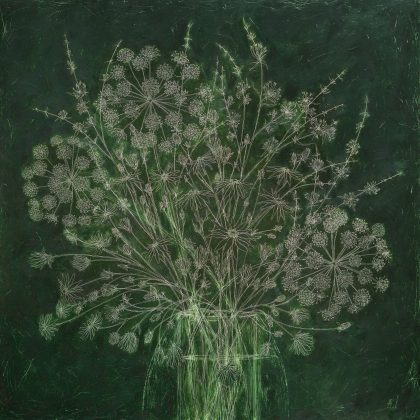
My Lauretta by Alissa Frazer
That technique continues to shift throughout her collection titled IN PIENA FIORITURA. Also part of that collection, and currently on display in Contours, is a Limoncello Toast, which acts as a toast to her family and a prompt for celebration. Alissa, being Sicilian, says her family has a lot of limoncello at family gatherings. The piece is meant as a remembrance of happy times and a way of calling them back. “So memories fade. Things happen, changes happen. But those moments when you’re so happy and you’re loved and feeling good, thats’s what this painting encompasses” she says.
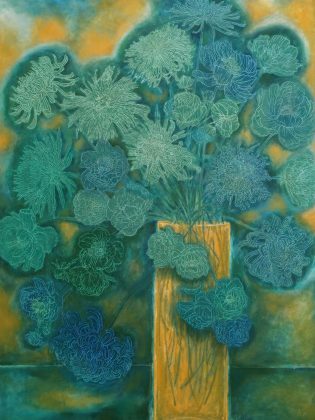
A Limoncello Toast by Alissa Frazer
For Alissa, the whole point of painting flowers is that they let her hold onto something that would normally disappear. She talks about loving “the fleeting beauty of it all” and how it’s “here one minute, gone the next,” and then she flips that reality on its head with paint. “Well, that’s why I paint it. Because when it’s on the canvas, it’s permanent. And then you get to live that moment every day when you pass it in your house, or when you pass it in the gallery or the building, it’s there. It reminds you of something celebratory.” In Contours, her work makes sense immediately. The exhibition is about line, shape, and form, and flowers give her endless ways to explore all three. The blooms show up at their peak, held in place long enough for you to actually look.
And that’s where the placement starts to matter as much as the painting itself. When I asked how she imagines her work living in an office or commercial environment, she said, “My hope is that people would stop their busy doings and look at it and take a breath and feel good about it. Maybe it’ll make them smile, you know, maybe it’ll give them some warmth or some comfort.” That’s the real value of a rotation when it’s done well. New work comes in, the space shifts, and people get a small moment of attention and reset built into the day, without needing to ask for it.
Written by David Dempsey, Director, Media Services & Content