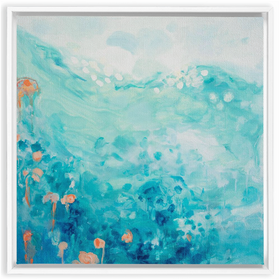
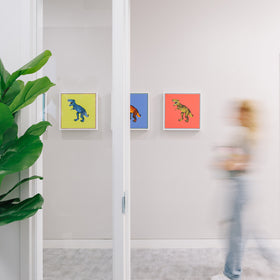
Parsley Steinweiss is a Brooklyn photographer based in Greenpoint whose sculptural works, built from photographs of the sky, explore light, color, and perception.
There’s something about birdwatching that requires an openness to the unexpected. You never know what you’ll encounter when you stop to look. I suppose meeting someone for the first time isn’t all that different.
On my way to meet Parsley Steinweiss, a Brooklyn-based photographer, jeweler and avid birder, I wasn’t entirely sure what to expect. There’s always a little nervousness that comes with stepping into someone else’s studio. But within moments of meeting her, that uncertainty disappeared. She greeted me with a warmth and openness that made conversation feel easy, and before long we were talking about her photography, her fascination with birds, and the surprising ways those two worlds intersect.
Parsley shares a studio in Greenpoint with her girlfriend, also an artist, and three other artists. They’ve had the space for about six months. She gave up her old studio in Bushwick during the pandemic and worked from home until this one came along. The room is full of bright light beaming through the front windows, which are covered in an iridescent film. What I don’t notice is a darkroom, which you’d expect a photographer to have, and that launches us right into conversation.
“I don’t process the negatives here,” she tells me. “I go to a photo lab to do all of that work, but I actually really love the light.”
Instead, she travels into Manhattan to print at My Own Color Lab, one of only a handful of color darkrooms left in the city. I ask if she makes the prints herself, and she does, booking time there like the rest of the city’s photographers who still print. “With color photography… you print completely in the dark. There is no red light or anything,” she says. “So I think that’s kind of fun too with my work, because I’m thinking about light and color, and then in the darkroom, it’s just darkness.”
The studio is for the second half of her process, and it’s what makes her work so unique. She takes these photographs for their light and color, but the prints themselves become the material she builds her artworks from. I’ll explain more, because even I was fooled the first time I saw these pieces unpacked and hung at Gallery 85. I thought they must be some kind of painted sculpture.
Everything in her studio is sky. The images on her walls, printed, cut and mounted into different shapes, all started as photographs of the sky that’s above all of us every day.
Parsley or Joplin Tomato?
A few weeks before our visit, we were sitting in a team meeting when one of our colleagues asked: is that really her name? So naturally, I needed to get to the bottom of it. As it turns out, Parsley isn’t the only unexpected name her parents gave their children.
“I don’t think I have the weirdest name in the family, actually,” she says. “My sister’s name is Joplin Tomato. Her middle name is Tomato. I don’t know, you decide. Parsley or Joplin Tomato?”
Her brother, for the record, is Homer. I did get the full story on her name, though. It comes from Parsley, a 1955 picture book about a deer by Ludwig Bemelmans, the author of Madeline. It’s out of print now, and she describes it as “kind of an environmental activist story,” which feels fitting for someone who loves birds as much as she does. It was also one of her mother’s favorite books growing up. Then she starts singing the Simon & Garfunkel song with the line “parsley, sage, rosemary and thyme,” which she says is the first thing most people bring up when they hear her name.
Her parents are musicians and artists themselves, or as she puts it, “kind of hippies, you know, a little bit.” Her father is still composing and working today. The family also has a fine jewelry business. Her parents ran it until they retired, and now Parsley runs it with her girlfriend. She works there three days a week and keeps Mondays and Fridays open for the studio, or for birding. The two sides of her life aren’t as separate as they sound.
“I think the art stuff informs the jewelry design, because I’m just thinking about color and light and form,” she says. “Everything informs each other.”
Parsley grew up in Manhattan and has been making photographs since middle school. In high school, a teacher taught her how to work in the darkroom, printing in black and white, and at Sarah Lawrence another teacher brought her into color photography. She later earned her MFA at Purchase. But it was a job at a fine art photo lab that changed the way she thought about the photograph itself.
“I think we think of photographs as images, but it’s really an image and a material at the same time,” she says. “So I started pushing that… I was ripping it, folding it. And then once I started mounting them, then it was a solid object.”
Pure light and color
Early in the morning is the best time to find Parsley looking up at the sky, capturing her images. She says that’s when the light is best. Lately she’s been shooting on a 35mm Canon, and some of her work is digital, but there’s a whole collection of cameras on a shelf in her studio that I’m positive have their own time to shine.
“For me, when I’m photographing the sky… I’m photographing pure light and color,” she says.
While we’re in the studio, she pulls out contact sheets to show me some of the process. Frame after frame of open sky: rich blues, gradients from blue to white and pink to orange, some with just the smallest hint of a tree branch or leaves pushing into the frame at the bottom. Sometimes she’ll wait until there isn’t a single cloud, so the whole frame is one pure gradient. When I ask if she adjusts the color, the answer is a quick no. “It’s totally in the sky.”
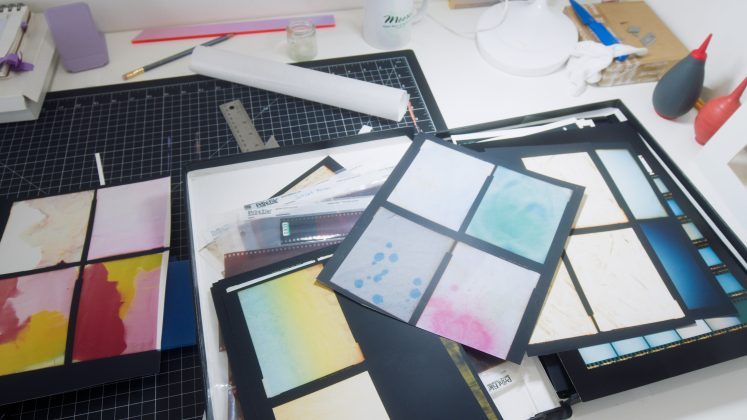
Contact sheets of open sky in Parsley’s studio.
For Parsley, these sky images are her raw material, and what she does next is the part that fooled me at Gallery 85.
“We’re surrounded by the sky. It’s this thing that’s constantly changing, but we don’t really pay attention to it,” she says. “And then once I photograph it and print it, it becomes a color field. It becomes an object that I can then use.”
That’s where the building stage comes in. She uses the prints to design and build the piece she wants. Maybe it’s a circle, or two triangles intersecting. It could also be something more intricate, with cutouts and layers.
Everything is mounted onto plexiglass right there in the studio. She walks us through it, feeding a print through her cold press, and we watch as she starts a new piece. She didn’t always do this part herself.
“I kept on going to the mounter and I was like, I want to do this crazy thing. I want to do this crazy thing. And they were like, okay, you’re a little crazy. You’re gonna have to do this yourself. I was like, fine,” she says. “So I really taught myself how to mount photographs.”
From there, the excess gets trimmed away, sometimes the middle is cut out to make a frame, and the shapes start to take… well, shape!
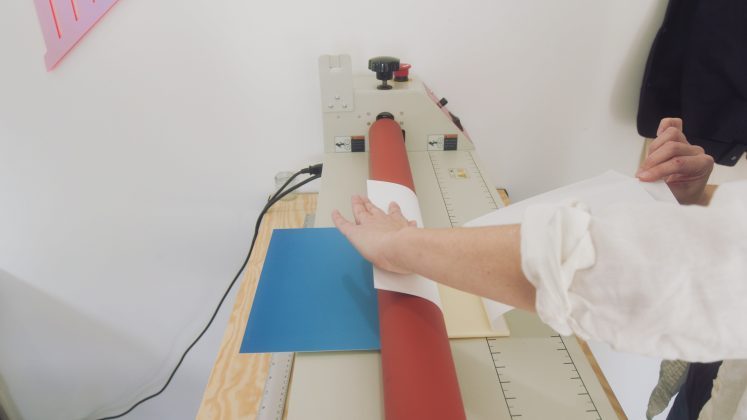
Parsley mounts a print to plexiglass with the cold press in her studio.
Always looking at the sky
For someone who is always looking up, it’s clear how the connection to birding came to be. “That’s kind of part of the work too, in a weird way, because I’m always looking at the sky,” she says. “I’m watching the seasons… how things change, and time and color and light.”
About three years ago, walking through the park that happens to be near her studio now, she saw a board put up by the local bird club. They’d spotted a northern flicker, a type of woodpecker, right there in the park. “I was like, how the heck did they see that bird here?” she says. Parsley knew the bird. She’d seen one at her girlfriend’s family farm outside Buffalo, and the idea of one turning up in a city park about a block long seemed impossible.
“So then I started going to the club, and then I was hooked, because I kind of learned how to bird.”
Three years later she’s “very obsessed,” in her own words.
When I ask about the best bird she’s found, she can’t pick just one, then admits to a soft spot for the most ordinary bird in the city. “Honestly, you’re going to think I’m so crazy, but sparrows… It’s the little brown bird that you see everywhere. I grew up here. I thought that that’s the only sparrow that existed in the world.” It turns out there are all kinds, some with white stripes on their heads, some with white chins, and for Parsley, finding that out was special.
That’s really what makes Parsley’s work unique. She takes something as simple as the sky, something all of us walk under every day without thinking twice, and shows it to us in a way that makes us stop and figure out what we’re looking at. I know it worked on me.
“Hopefully my work does a little bit of that, actually, because you’re trying to figure it out,” she says. “And I think taking the time to look at things is really important.”
That way of looking is what she brought to Purview, the group show at Gallery 85 where I first saw her work.
Between photography and object
Gallery 85 sits in the lobby of a New York office building, which makes it a different kind of gallery. Most of the people who see Purview are on their way to work, and whether they stop to look is up to the art. That’s an audience our team thinks about a lot, because it’s the same one we curate for in hotels and apartment buildings, where art becomes part of someone’s everyday routine.
Purview is the gallery’s eighth rotation, curated by our Director of Curation, Sarah Mohrman. A purview is the range of what we see or understand, and as Parsley sees it, the show “brings together all these artists that are really deeply looking at things.”
When Sarah talks about Parsley’s work, she starts with perception and the way Parsley approaches it through photography. “Her work asks us to question what a photograph actually is,” Sarah says. “Instead of simply documenting the world, she uses light, color, shape and dimensional surfaces to construct something that sits between photography and object.”
Parsley describes it almost the same way. “I have a hard time defining my work, honestly, because the work is really rooted in photography, but it has sculptural aspects to it,” she says. “I think it lives in between photography and sculpture.”
There are three of her pieces in Purview, and all three started as photographs of the sky.
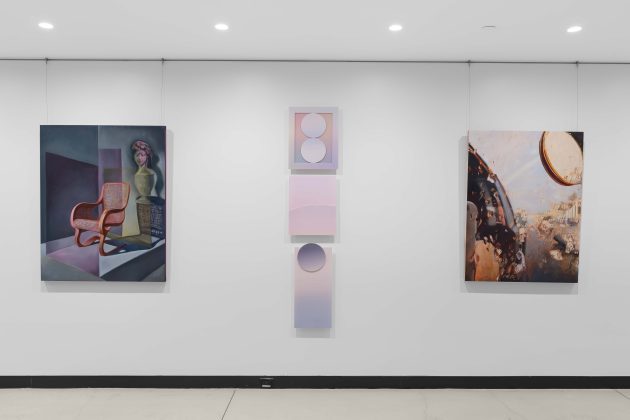
Parsley Steinweiss’s work installed in Purview at Gallery 85.
Hollywood Hills (2025), the newest of the three, is a soft field of pink and lavender with a ridge line cutting across it, and it’s one of the pieces she had planned out from the start. “I had that idea in my head. I wanted that specific landscape,” she says. “I had taken that picture as I was going to LA, actually, through the plane.” That view from the plane window is where the shape of the hills comes from.
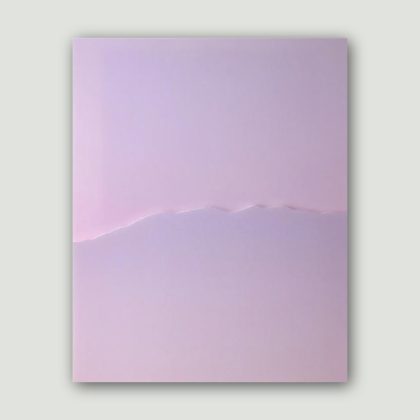
Parsley Steinweiss, Hollywood Hills, 2025. Digital photographic prints mounted to plexiglass, 15.25″ x 19.25″.
Balanced Forces (2022) stacks two circles inside a frame, with the color shifting from a warm blush at the top to cooler blues and lavender at the bottom. It was part of a series of four frame pieces, each with circles in different sizes. “I was thinking about complementary colors,” she says. “The two circles, kind of inhabiting the space within a frame, and this almost pushing out of it.”
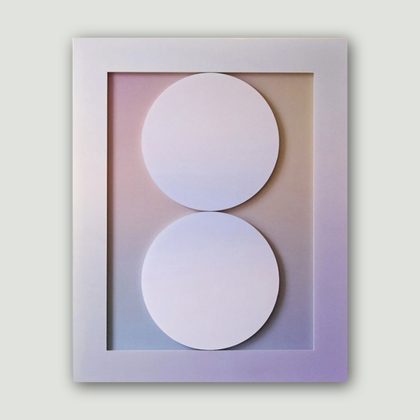
Parsley Steinweiss, Balanced Forces, 2022. Digital photographic prints mounted to plexiglass, 16″ x 20″.
Sarah points to this piece to explain what makes Parsley’s work different in person. “These two circular forms are incredibly minimal, but as you move around the work, light and shadow continually change what you’re seeing,” she says. “That physical experience is important. It’s a photograph, but it doesn’t behave like a traditional photograph.”
Phases 2 (2021) is a tall, narrow panel with a slate-colored circle near the top, set over a gradient that fades from pale peach to soft blue. She made it as one part of a triptych about landscape. “There’s a circle in the piece. I mean, you can interpret that as you want, but I guess I was thinking about celestial bodies,” she says. It’s hard not to see a moon in it.
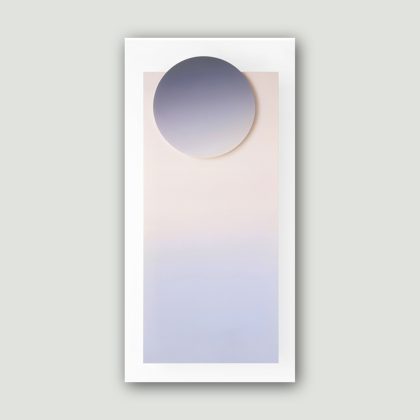
Parsley Steinweiss, Phases 2, 2021. Digital photographic prints mounted to plexiglass, 12″ x 28″.
When I ask how the word purview fits her work, she goes back to perception. “I think purview fits into my work because I’m thinking about how to see,” she says. “I’m thinking about perception, and questioning it. What does it mean to look at something? What does it mean for a camera to look at something?”
It’s a fitting word for her. Everyone who walks into that lobby in the morning has just come in from under the same sky, and her work shows it back to them in a way they might not recognize at first.
“With my work, I’m thinking about sky,” she says. “My purview of the sky. And I hope other people can see what I see.”
Throughout the day
Early in the visit, I ask whether her pieces change depending on where you stand. They do, she tells me, pointing to the shadow on a new circle piece hanging in the studio, and they change throughout the day, too.
“I really love that too. If someone lives with the piece it will change throughout the day. And if it’s a cloudy day, maybe the glow will be less, or if it’s a bright day, this glow from the plexi will change also.”
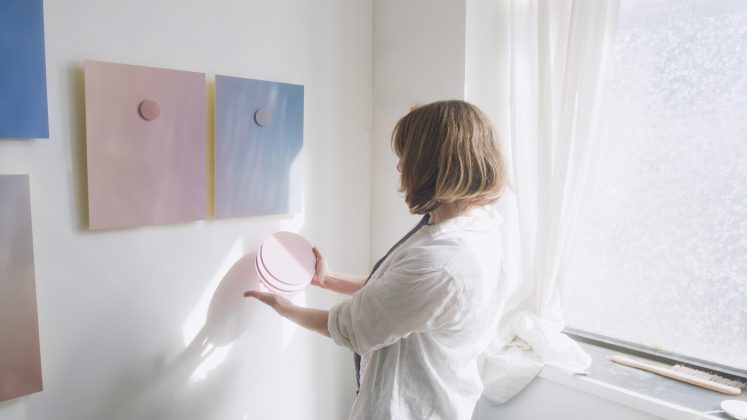
Parsley holds up Time Lapse (2026), made from three different exposures, to the window light in her studio.
That matters for the kinds of spaces we curate. In a lobby or a hotel, people walk past the same wall every day, and a piece that looks a little different each time gives them a reason to keep noticing it.
Since most people will see her pieces at Gallery 85 on the way to their desks, I ask what she hopes they do for someone at the start of their day. Her answer comes back to looking.
“I really hope that it engages with people to stop and look… It’s a very important part of being human. And I think we so rarely do that. Now we’re just fed information on our phones, and we’re not really thinking about looking. And I hope that people take the time to just meditate in the space and look.”
Gotta look
Lately, Parsley has been trying to pay more attention to the moon, something she says we hardly notice even though it’s around us all the time. She tells me about a little girl in the park, about two years old, who has started pointing it out.
“She can’t even really talk. But she says to her mom, ‘Look, there’s the moon,’ when it’s a day moon. And I just think that’s so amazing for a child to notice that. Because I feel like we don’t even really notice the moon, you know, or the sky.”
She says so many people are shocked to learn that her pieces are photographs of the sky. “These colors are in the sky, you know?”
“You gotta look,” I tell her.
“Gotta look,” she says.
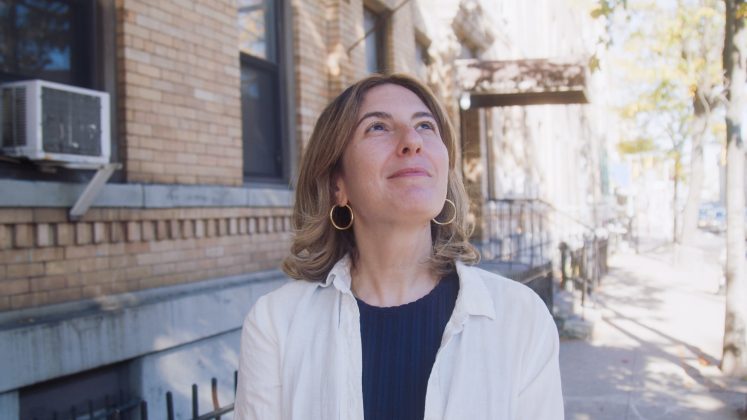
Parsley looks up outside her Greenpoint studio, keeping an eye on her purview of the sky and whatever might fly through it.
After the interview, we get to chatting about the neighborhood around her studio, and Parsley wants to take us outside to look up. Out on her street in Greenpoint, she spots a bird in one of the trees, and there’s an energy and electricity in her eyes as she tries to point it out to me. I never do see it. But having her point it out, and introduce me to the world of looking up, is fascinating and exciting. I wouldn’t have thought you could even do that in a city as busy as New York.
You never know what you’ll encounter when you stop to look.
Where to see it
Hollywood Hills (2025), Balanced Forces (2022), and Phases 2 (2021) are featured in Purview at Gallery 85, curated by Sarah Mohrman.
Parsley also regularly shows with Treat Gallery at the Affordable Art Fair.
See more of Parsley Steinweiss and learn more about Purview here.
Read more about Rebecca Bird, another artist featured in Purview.
Read more about Esther Ruiz, another artist featured in Purview.
Read more about Polly Shindler, another artist featured in Purview.
Written by David Dempsey, Director, Media Services & Content